

Forum Replies Created
-
AuthorReplies
-
A good comparison for the Master Anamorphics vs. older anamorphic lenses is Robert Yeoman’s work with Wes Anderson. The 2.39 scenes in The French Dispatch and Asteroid City are Master Anamorphics. Older films they did together like The Darjeeling Limited, The Life Aquatic, The Royal Tenenbaums, and Rushmore are Panavision. The 2.39 scenes in The Grand Budapest Hotel are Technovision. All of these movies were shot on film and everything from The Life Aquatic onward was a digital intermediate.
It’s not quite as clean a comparison but you could also look at the recent Star Trek movies. Star Trek 2009 and Star Trek Into Darkness were shot on film with Panavision lenses by Dan Mindel, and then Star Trek Beyond was shot on digital with the Master Anamorphics by Stephen Windon.
If limited to a single prime for a documentary, a lot of what would make me go wider would simply be that I couldn’t anticipate how close I’d ever end up to the subject, or if I’d constantly be closing and then gaining distance, or trying to hold multiple subjects in frame. In that situation I would rather be somewhat wide even if it could end up unflattering in certain compositions.
Shooting digitally, you would always have the option of magnifying the image if you found that what you really needed at a certain moment was a telephoto lens and you didn’t have one, but the opposite isn’t true. If you were on a longer lens than you needed to be you’d either have to physically move away or settle for a composition that felt too tight, and then maybe pan back-and-forth depending on what was happening.
If I wanted a single prime lens for documentary work on a Super 35 sensor I would probably gravitate to something like the 25mm or 27mm Master Prime as well. The focal length would be suited to a variety of compositions from close-up to wide shot, the wide aperture & the lack of flaring would be good if I didn’t know exactly what lighting conditions would be encountered, close focus is 14″, etc. I’m still not sure if I would buy one though. I might try to find an f/1.4 lens around the same focal length that was at least half as expensive and put the rest of the budget elsewhere. Another user mentioned the Zeiss Otus and I think the 28mm would be a good compromise. You could buy a brand new one and get it cine-converted through Duclos for half of the price of the 25mm MP.
September 3, 2023 at 8:19 pm in reply to: Is the craft of lighting black and white different from color? #214903I think the main thing to keep in mind is that even though in black & white photography the separation of different elements is coming primarily through contrast and composition, color definitely still matters because of tones. If you take the example of a very deep red brick house against a very purple-violet sky, the tones of those two things will actually look fairly close in B&W and it will be a much flatter image than it is in color. If you ignore color on set and then try to window everything in the grade it might end up being a fairly long and painstaking process.
Part of what you responded to may have also been a difference in projection, if the 4k restoration was a DCP and not a film print as it would have been 20 years ago, if the screening room itself had better viewing conditions, etc.
I’ve only read Blain Brown’s book on digital imaging and that was several years ago but I remember thinking at the time that it was an excellent primer. To Stip’s point, Brown’s books aren’t really prescriptive, he’s not teaching you ‘his’ way of doing things, the concepts are much more elementary and aimed at the beginner.
I don’t think Kubrick actually shot wide-open on the Zeiss Super Speeds all the time on those movies, partly because he mixed lenses in scenes, sometimes Cooke zooms were used, plus the Zeiss VariPrimes were also used on “Eyes Wide Shut”. So the sets weren’t always lit to only f/1.4.
What would you guess the f-number of a lot of those interiors in Eyes Wide Shut was? I’ve heard conflicting things over the years about how they developed the stock. In the ASC article back in ’99 Larry Smith was quoted, “We decided that if we pushed everything two stops, it would really have the effect of an extra stop and a quarter or a stop and a half.” People have asserted that they printed down but that’s never mentioned in the article. I got the impression Smith was saying that even force developing two stops and then keeping the negative that thin, they found that it was really more like 1125-1250 ASA rather than 2000 ASA.
Even at 1125 ASA, that would be something like 2 footcandles at f/1.4 for 18% grey, and then 10 footcandles for the T3 Cooke zoom? Which seems about right for the light levels in many scenes. Smith is quoted in the same article, “We decided to shoot nearly all of the picture at a stop of T1.3, and since we were pushing everything, we were able to create a wonderful warm glow.”
I can’t tell when they used the VariPrimes but I vaguely remember another interview with Larry Smith where he said that most of the movie is steadicam, and it wouldn’t have made sense to use them for those setups.
I can’t think of any feature films that went with a non-standard shutter angle for the entire running time, but when Michael Mann went digital he frequently would turn the shutter off, and you can see how that effects cadence of motion in several scenes in Collateral, Miami Vice, Public Enemies, and Blackhat. Janusz Kaminski used 1/96 and even 1/192 shutter speeds throughout the action scenes in Saving Private Ryan.
I’ve heard people talk about f/1.4 lenses as if their maximum aperture were a measure of last resort, but of course there have been several films that were shot that wide as a rule. After the Zeiss Super Speeds came out they became Stanley Kubrick’s predominant lenses, with much of The Shining, Full Metal Jacket, and Eyes Wide Shut shot wide open on them. I believe all of Let the Right One In was shot wide open on the Super Speeds by Hoyte van Hoytema. All of The Social Network was shot wide open with the Master Primes, and I think David Fincher has held to that ever since with the Leica Summilux-C’s.
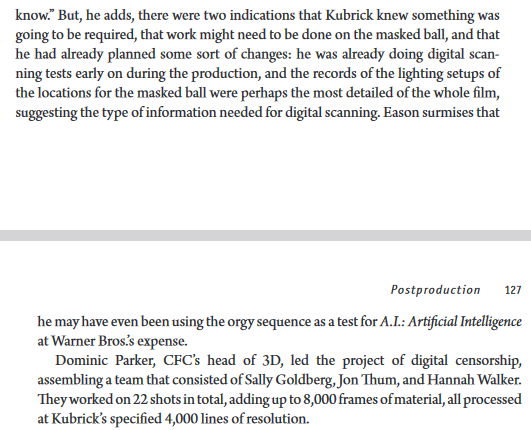
In Rober Kolker & Nathan Abrams’ book on the making of Eyes Wide Shut (screen capture attached to this comment) it’s mentioned that Kubrick was looking into digital scanning for the film. Kubrick also went into pre-production on A.I. when he saw what was possible with digital effects in Jurassic Park, and he had extensive conversations with people at Industrial Light & Magic.
Roger, when you were still using an optical process for Super 35 would you expose it any differently versus regular 35, or go through a different post-process like double-printing the dupe or using silver-retention? Did your approach to stocks and exposure change at all when you started using a DI?
June 21, 2023 at 12:54 pm in reply to: How to make a small and confined space appear more spacious. #214630Depending on the action of the scene and what’s appropriate for the story, you could consider things like wide-angle focal lengths, compositions with the camera at a very high or very low angle, multiple planes of action, shallow depth of field, dressing the set so that it’s uncluttered and has a vanishing point as far away as possible, etc.
You could also go in the opposite direction and use longer focal lengths with the camera far away from the subject, and do things like crowd the frame to suggest a larger space out of the periphery of the shot.
If it’s viable you could also black out some of the set to suggest a larger space that disappears into shadow, or have a lot of separation of planes with lighting instead of depth of field. Haze & smoke would also add depth.
If renting isn’t an option, the least expensive camera I’m familiar with that can shoot UHD 4K in 120 fps is the Sony FX30.
Complaining that your posts have been deleted and then proceeding to pontificate about “living in a democratic world” in which you “enjoy freedom of speech” is quite clear. Again, you enjoy neither of these privileges on a privately owned website — any of your posts can be deleted at any time and for any reason. Because things like tone don’t necessarily come across in text you can of course claim you meant anything, even that your comments were ‘ironic’ or whatever, but I would suggest that if your interest in a forum about cinematography and filmmaking leads you down this route you should reassess why you’re participating in the first place. It’s for this reason that I have no interest in continuing this discussion with you. For those with an interest in viewing the old forums I hope the links to the web archives were helpful.
In my original post I intentionally avoided singling out any individual person so as not to be invidious. Needless to say I was referring to multiple forum users who have posted in this topic. I’m not sure how me saying “You are on a private website that the Deakins’ can administrate however they wish” could refer to any posts Vanniyan made, and in fact it’s in direct reply to bizarre statements made by others like “Thank God we live in a democratic world where we enjoy freedom of speech.”
I particularly resent the accusation that I’m somehow being insensitive toward somebody because they don’t have native fluency in English. Bad manners like being presumptuous (“You are too busy making the podcast and ‘Byways'”) or badgering someone for something, repeatedly asking the same questions and making the same requests when you don’t receive a reply as soon as you would like, are not a matter of a language barrier.
-
AuthorReplies
