

Forum Replies Created
-
AuthorReplies
-
The color palette of “Blade Runner 2049” is not really due to the LUT, that’s lighting and design mostly. If it were due to the LUT, then all of Roger’s movies shot on the Alexa would have the same color palette!
I wouldn’t over-emphasize the importance of the LUT in terms of cinematography. It is a relatively minor thing compared to lighting, composition, exposure, lenses, etc.
Most LUTs exist to transform a log image into a display gamma so that the contrast and saturation can be correctly evaluated. They may have some personal adjustments in terms of gamma in the shadows, midtones, and highlights, and in saturation.
My method for creating the shooting LUT on the Alexa is to shoot a face and some charts, record them in Log-C (or Arriraw converted later to Log-C), and then take them to a post house to color-correct them and then have the colorist generate a LUT.
I shoot a face and some charts (grey scales, etc.) separately and color-correct both and toggle back and forth to see how my corrections for the face affect the charts and vice-versa. That way I end up with a LUT that works both for a real face and for a grey scale.
As a reference on the testing day, I also record a baked-in Rec.709 version (since I’m shooting for broadcast HD) so I can compare my LUT to what ARRI thinks is a basic conversion LUT for Log-C to Rec.709. I guess one could do the same thing in P3 for a theatrical project but you’d have to think about whether dailies will be in Rec.709 and whether your main set monitors are P3.
Keep in mind that the LUT is mainly just for on-set displays and for dailies creation. The final color-correction might start from scratch from the log image or use the LUT as a starting point.
I have a DIT on my crew so I can make adjustments on the day (like to match two lenses that don’t quite match in color, or add contrast in flat weather or reduce contrast in harsh light) — these are sent as ASC-CDL files to the dailies colorist to apply to the LUT. If I didn’t have a DIT, I might be tempted to create three LUTs (basic look, a slightly low-contrast version, and slightly high-contrast version) but you’d have to think about whether you’d just be making life too complicated for your ACs and your dailies colorist.
I once wrote my own list of personal favorites of cinematography and there were dozens of titles per decade of the history of cinema. Anyone can recommend five movies with great cinematography… but as soon as you watched them, there would be five more to watch, and so on! I think what movies you want to learn for depends more on what specifically would you like to learn.
It’s similar to when someone asks what five books they should read on filmmaking. In my mind, if someone is a fan of a subject, they will read everything they can find, good or bad. Imagine someone saying they were a huge fan of U.S. Civil War history but then saying they want to only read a couple of books on the topic.
I would just start watching good movies.
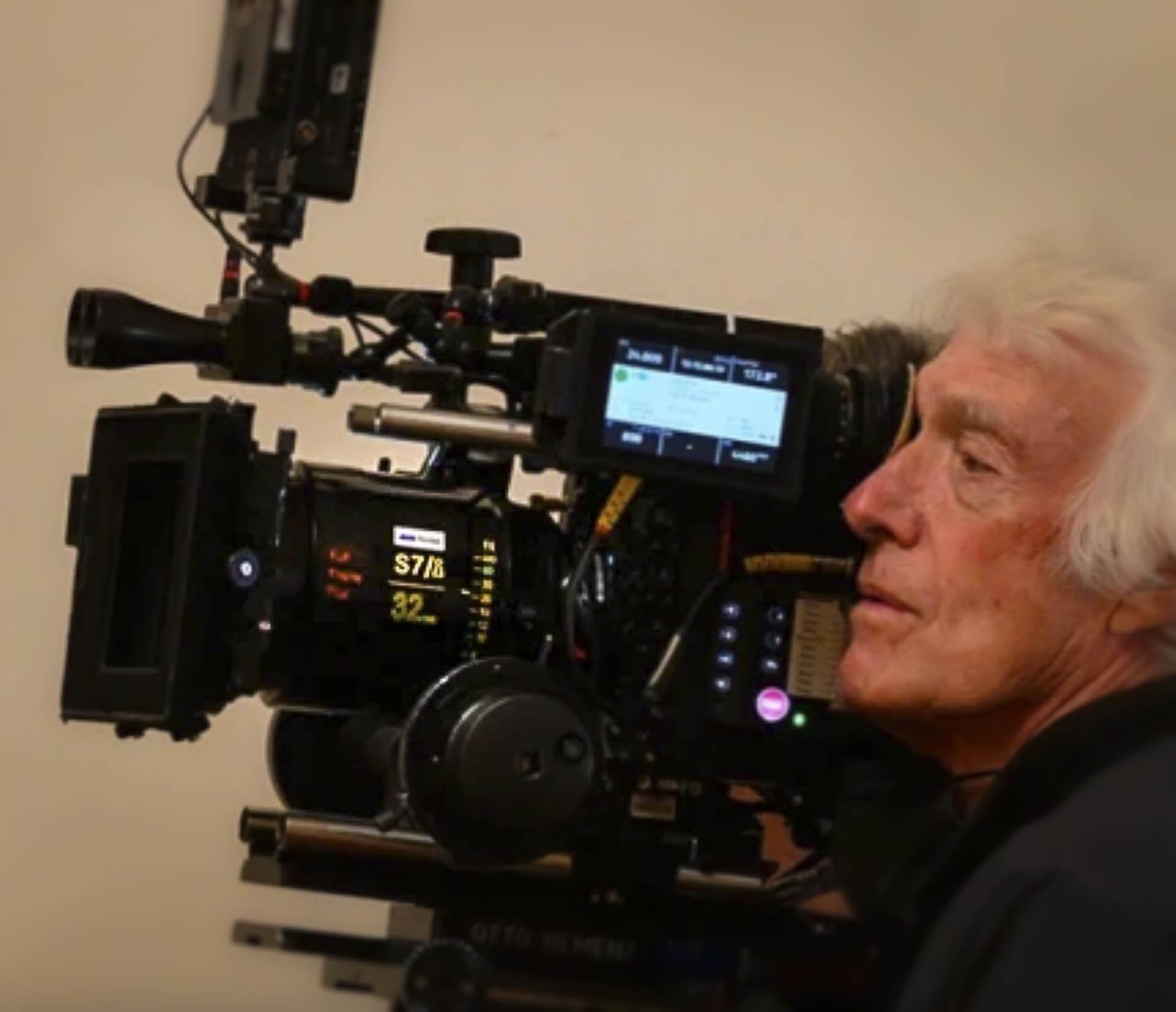
Certainly looks like a Cooke S7
It seems to me that with Vision3 color negative on an open beach in sunlight, you’ll have plenty of highlight and shadow detail with all of the light bouncing off of the sand.
Yes, but “Shawshank Redemption” was 1994 so there wasn’t a D.I. done originally. What I’m saying is that if “The Company Men” (2010) went through a D.I., there already exists a color-corrected digital master… so why would anyone retime it again for new video masters? Even if it was a 2K D.I. master from 2010 and now had to be uprezzed to UHD/4K, there’s no reason to change the colors. The only reason I can think of to spend the time re-coloring the whole movie would be if an HDR version was requested.
ACs and operators usually crank-up the camera’s onboard monitor to help with framing and focusing so I never use those as a judge of the image. The best monitor on set is at the DIT cart, the second best is on set with the director, on a stand to be mobile. Both are large monitors. After that, it is hit or miss in terms of the quality at different stations but today a lot of crew people have an image streamed to iPads. If the director really needs to be mobile they will use one of those.
1. Be grateful for whatever Roger and James can give you in terms of their time and experience.
2. The podcasts are an entirely different thing than this forum, they are wonderful interviews with filmmakers talking about their careers, their lives, and their art. No reason to compare the podcast to the forum.
3. The value of some things are not in their utility, not in what practical use they are for you. Some things just enrich you as a person, as an artist.
I don’t understand why a movie that went through a D.I. and has a digital master would have the colors changed for any version.
What I mean by fundamentals is that you aren’t relying on someone else to expose the shot for you. There are basic aspects to photography like f-stop, shutter speed, ISO, frame rate for example that I think any cinematographer has to understand the principles of or else they are lost. But does a cinematographer have to know the data rate of ProRes 444HQ at 3.2K, 24 fps? Do they have to know the chemicals in ECN2 color negative processing? Do they have to identify all the elements in a Cooke prime lens? Probably not.
I think Gordon Willis said to the effect that if you don’t how to achieve an idea, then you’re in trouble — but if you don’t have any ideas, you’re really in trouble.
I had a chat with Richard Crudo, ASC at NAB one year about that — he said every cinematographer is different in terms of how many layers of the onion they want to peel back. There’s a vague point where, of course, it crosses the line from practical knowledge to merely satisfying intellectual curiosity. We need to know enough to identify and solve problems, or at least, know who to ask. We need to know enough to get the results we desire, or at least, hire people to help us get those results. There are plenty of technical experts in this industry to get answers from, so to some degree, it depends on how reliant you want to be on other people. Ultimately the one thing that we have to supply is the artistic idea, our visual taste, and our storytelling skills, and then we have to know enough to achieve our ideas, even if that means consulting with experts when necessary.
Certainly one has to know the fundamentals of photography and lighting.
Reversal film has no latitude for mis-exposure — I spent ten years shooting Super-8 and 16mm reversal before and during film school. You lose detail at either end so quickly that you really have to bias your exposure for the subject’s tonal values.
Spot metering may help though I used an incident meter, so what I did is that if the subject was mostly dark tones, I’d open up and if it was mostly light tones, I’d stop down.
The original image was probably closer to this without the skip-bleach effect:

One doesn’t always want or need shadow detail. I mean, a silhouette shot is a black shape with no shadow detail.
In my case, I had plenty of shadow detail, this was 100 ASA film stock, well-exposed, and I was flashing the negative 15%. But the prints went through a skip-bleach process to increase contrast, so I deliberately shot a low-contrast negative and in the video transfer from a low-contrast IP, I had to simulate the higher contrast of the theatrical prints by crushing the shadow detail down or else everything would look flat.
Larger formats use longer focal lengths for the same field of view so have less depth of field, so yes, you have to stop down if you want to counteract that.
Generally that means more light… but larger sensors tend to handle higher ISO settings because the increase in noise is less obvious, so you can partially compensate for the lower depth of field by increasing the ISO — you could, for example, go half and half, boost the ISO a little, boost the light level a little.
However, some people shoot larger formats precisely because they like the shallower depth of field.
I know it’s hard but if you’re a beginner in the industry, you want to me known as the person who maintains a positive attitude even when things get tough, not the person who is only pleasant when the hours are pleasant. However, if you’re not being paid and the job is terrible, then I don’t think anyone would object if you left for a better job that paid.
-
AuthorReplies
